A new development in the navigation situation in the Strait of Hormuz is emerging that warrants close attention from the shipping industry. Amid ongoing tensions in the Middle East and a sharp rise in security risks in the strait, a full resumption of normal shipping has not been realized. However, a more practically meaningful trend has gradually become clear: some countries are engaging in direct communications with Iran to seek the phased, case-by-case resumption of passage for their key energy transport vessels.
Among these, India’s actions have drawn particular attention. According to Indian officials and reports including the Financial Times, India is in communication with Iran to secure the safe eastbound passage of approximately 30 Indian-flagged vessels through the Strait of Hormuz. At least 22 of these vessels are energy-related, including 3 LNG carriers, 11 LPG carriers, and 8 crude oil tankers.
India’s Directorate General of Shipping has also stated that it is arranging naval escorts and other measures to assist relevant vessels in evacuating high-risk areas. Meanwhile, India has appointed the Deputy Director General of the Directorate General of Shipping to handle shipping issues related to the Middle East conflict.
Notably, India’s statements indicate that this is not merely a matter of military escort, but a combined operation of diplomatic coordination plus prioritized vessel clearance. Indian External Affairs Minister S. Jaishankar has publicly stated that he is in direct contact with Iran and that “some results have already been achieved”.
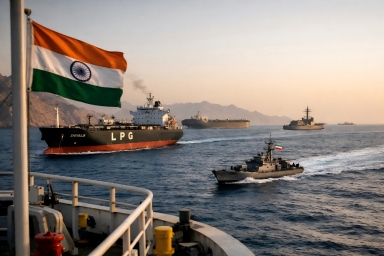
Indian media later revealed that India is currently adopting an approach of vessel-by-vessel negotiation and case-by-case progression, rather than waiting for the Strait to return to full normalcy before granting unified clearance. In other words, the current logic of passage through the Strait of Hormuz is shifting from “whether to open” to “who can pass first and in what manner.”
In practice, this kind of “limited clearance” has already begun to take effect. Reports indicate that two VLGCs controlled by the Shipping Corporation of India (SCI) — the Shivalik (built in 2008) and the Nanda Devi (built in 2001) — successfully transited the Strait of Hormuz last Saturday and are returning to India for discharge. Their passage is widely viewed by the market as an important signal of phased progress in India’s negotiations with Iran.
Besides India, Pakistan is taking a similar approach. According to a Reuters report on March 16, the Aframax tanker Karachi, operated by Pakistan’s national shipping company, has successfully passed through the Strait of Hormuz. The report noted that the Pakistan Navy has launched operations to safeguard its energy transportation security, and Pakistan has reportedly coordinated with Iran to obtain guarantees for safe passage.
Notably, the vessel did not receive naval escorts during its transit. This suggests that, under current conditions, the primary method for countries to secure passage for their key vessels may not be open large-scale military escorts, but rather diplomatic channels and regional security coordination to achieve “targeted resumption” for specific ships.
Turkey’s case further confirms this trend. On March 13, Reuters reported that Turkey’s Minister of Transport stated that the Rozana, a vessel owned by a Turkish shipowner, had transited the Strait of Hormuz after receiving Iranian approval. However, among the 15 Turkish-related vessels, only this one was cleared at that time, with the remaining 14 still under negotiation. This case is highly typical: it shows that the Strait has not simply “resumed normal shipping,” but has instead entered a new state of gradual clearance by vessel, batch, and diplomatic outcome.
Against a broader backdrop, this shift is hardly surprising. The Strait of Hormuz is one of the world’s most critical energy shipping lanes.Following the recent escalation of tensions, importers, shipowners, charterers, and insurance markets worldwide quickly entered a state of high alert.
A separate Reuters report on March 16 quoted U.S. Treasury Secretary Janet Yellen as saying that Washington has “no objection” to Iranian, Indian, and some Chinese fuel carriers passing through Hormuz, adding that Iran appears to be creating a kind of “natural opening.” While this does not mean the situation has stabilized, it at least indicates that passage through the Strait is now characterized by partial resumption under political screening and risk control.
For India, advancing these vessels’ passage carries strong practical urgency. Reuters disclosed that approximately 90% of India’s LPG imports come from the Gulf region. Amid the current tensions, several Indian-related vessels carrying LPG remain in the area awaiting further arrangements.
At the same time, India’s negotiations with Iran are not a one-way concession. Reports state that Iran, in discussions with India over safe passage through Hormuz, has also demanded that India return three Iranian-related oil tankers previously seized. This means that the current “transit coordination” is likely not merely a shipping issue, but also involves broader bilateral political and strategic factors.
From an industry perspective, the key judgment is clear:The Strait of Hormuz has not truly returned to normal shipping, but the scenario of “complete closure” is also being broken. Instead, a more complex and realistic operating mechanism has emerged: certain countries are engaging directly with Iran to secure limited, safe, and batch-by-batch passage arrangements for their priority energy carriers. The recent moves by India, Pakistan, and Turkey are direct manifestations of this new model.
This has several direct implications for the shipping market:
1. The right of passage through the Strait is taking on stronger national and diplomatic attributes.In the period ahead, permission to pass through Hormuz may depend not only on commercial decisions or military escort capabilities, but also on vessel flag, cargo type, diplomatic relations, and real-time political negotiations.
2. LNG, LPG, and crude oil tankers will remain the market’s focal vessel types.The vast majority of vessels India is seeking to clear are energy carriers, reaffirming that energy supply security remains governments’ top shipping priority under current tensions.
3. Uncertainty over freight rates, insurance premiums, and operational arrangements will remain elevated.As long as the overall mechanism remains vessel-by-vessel coordination and batch-by-batch clearance, the market will struggle to return quickly to normalcy. For shipowners, charterers, energy importers, and traders, the real question is no longer “whether operations have resumed,” but which vessels can sail first, which must wait, how long, and at what cost — the core uncertainty in today’s Hormuz market.
For China’s shipping industry and energy transportation market, this shift also deserves continuous monitoring.On one hand, it demonstrates that, amid extreme geopolitical shocks, key maritime chokepoints can be partially restored through means beyond military escorts.On the other hand, it reminds all industry participants that the security of international energy shipping may increasingly depend on diplomatic coordination capabilities, country-specific risk management, and the ability to quickly adapt to transit regimes in high-risk waters.